

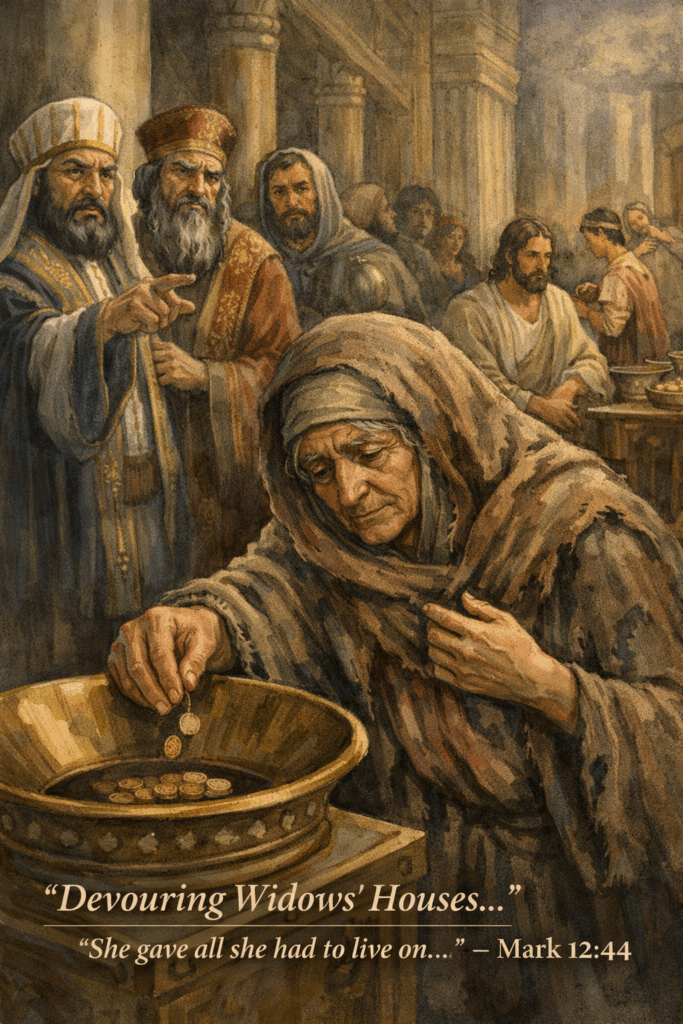
Mark 12:41-44 (LSB):
41 And He sat down opposite the treasury, and began observing how the crowd was putting money into the treasury; and many rich people were putting in large sums. 42 And a poor widow came and put in two lepta, which amount to a quadrans. 43 And calling His disciples to Him, He said to them, “Truly I say to you, this poor widow put in more than all those putting money into the treasury; 44 for they all put in out of their surplus, but she, out of her poverty, put in all she owned, all she had to live on.”
What comes to mind when we read these words? Is it that we must give sacrificially, that if we just give more, God will bless us more? You’ve probably heard this taught, and shortly after, the offering plate was passed.
But what if we’ve been reading this passage backwards? What if this isn’t a story about an exemplary giver, but a tragedy about a broken system that devoured the very people it was supposed to protect?
Look at the Context
We cannot rip verses 41–44 from the passage around them and expect to understand what Mark is telling us. In verse 35, Jesus is teaching in the temple. By verses 38–40, He issues a blistering indictment of the scribes, men who loved their flowing robes, their seats of honor, and their lengthy public prayers. And then this: they “devour widows’ houses” (v. 40). That is not a minor footnote. Jesus says that because of this, “they will receive the greater condemnation.”
Immediately after that warning, Jesus sits down across from the treasury and watches a widow drop in everything she had to live on. And then, just verses later in chapter 13, He walks out of the temple and tells His disciples that every stone of that place will be thrown down. The temple, and the system it represented, was coming to an end.
Do you see the flow? Jesus condemns the religious leaders for exploiting widows. Then He watches a widow give away her last two coins to that very system. Then He announces the system’s destruction. This is not a warm illustration about generous giving. It is the climax of an indictment.
What the Text Actually Says, and Doesn’t Say
Notice what Mark emphasizes. He tells us she was a “poor widow.” He tells us the coins were small. He tells us she put in “all she had to live on,” literally, her whole life. Mark underscores her poverty no fewer than five times. The text wants you to feel the weight of what this woman surrendered.
Now notice what Mark does not say. He never tells us why she gave. He does not say she gave out of love, or trust, or joy. He does not say she was cheerful about it. He does not say Jesus praised her or held her up as a model. Jesus simply states the fact: the rich gave out of their surplus, but she gave out of her poverty, everything she had.
Some read Jesus’ words in verses 43–44 as commendation, a positive comparison. But comparison is not the same as commendation. Jesus can observe that her gift cost her more than anyone else’s without endorsing the system that took it from her. In fact, given that He just condemned the leaders who “devour widows’ houses” and is about to announce the temple’s destruction, the most natural reading is that this widow is a living example of the very exploitation He has been denouncing.
Why This Matters for Us
Here is where this gets personal. When pastors use this text to pressure people into giving more, “If this widow gave everything, what’s your excuse?”, they are doing the very thing Jesus condemned the scribes for. They are using spiritual authority to extract from the vulnerable. That is not faithful preaching. That is manipulation dressed in religious language.
The Bible does teach about giving, and it does so beautifully. But the model is 2 Corinthians 9:7, “Each one must do just as he has purposed in his heart, not grudgingly or under compulsion, for God loves a cheerful giver.” Biblical giving flows from a willing heart, not from guilt, not from a preacher’s pressure, and not from a misapplied story about a widow who was exploited by the very system that should have cared for her.
We also need to be honest about what this passage does not teach. It does not teach that if you give God everything, He is obligated to provide for you on your timeline. God does provide, but He is not a vending machine we manipulate with sacrifice. To read this passage as “give everything and watch God come through” is to test God, not trust Him.
The Heart of It
Mark 12:41–44 is not a fundraising text. It is a grief text. Jesus watches a woman ground down by poverty surrender her last coins to a corrupt institution, and He knows that institution is about to be dismantled. The tragedy is not that she gave too little. The tragedy is that a system claiming to represent God failed to protect her, just as it was designed to do under the Law (Deuteronomy 14:29; 24:17–21).
So what do we take from this? Guard your heart against any teaching that uses guilt to open your wallet. Give generously, yes, but give as one who has been freely given to by God, not as one compelled by a misreading of Scripture. And if you are a leader: protect the vulnerable. That is what the scribes should have been doing. That is what Jesus expected. And it is what He still expects of those who shepherd His people.
— Chris Randall